How Payment Gateways Evaluate High-Risk Merchants
Merchants in high-risk categories often hear the phrase “gateway review” when accounts are restricted or closed. What’s rarely explained is what evaluation actually means, who performs it, and how decisions are made over time. This page explains the evaluation process in practical terms, without shortcuts or assumptions.
What “evaluation” really refers to
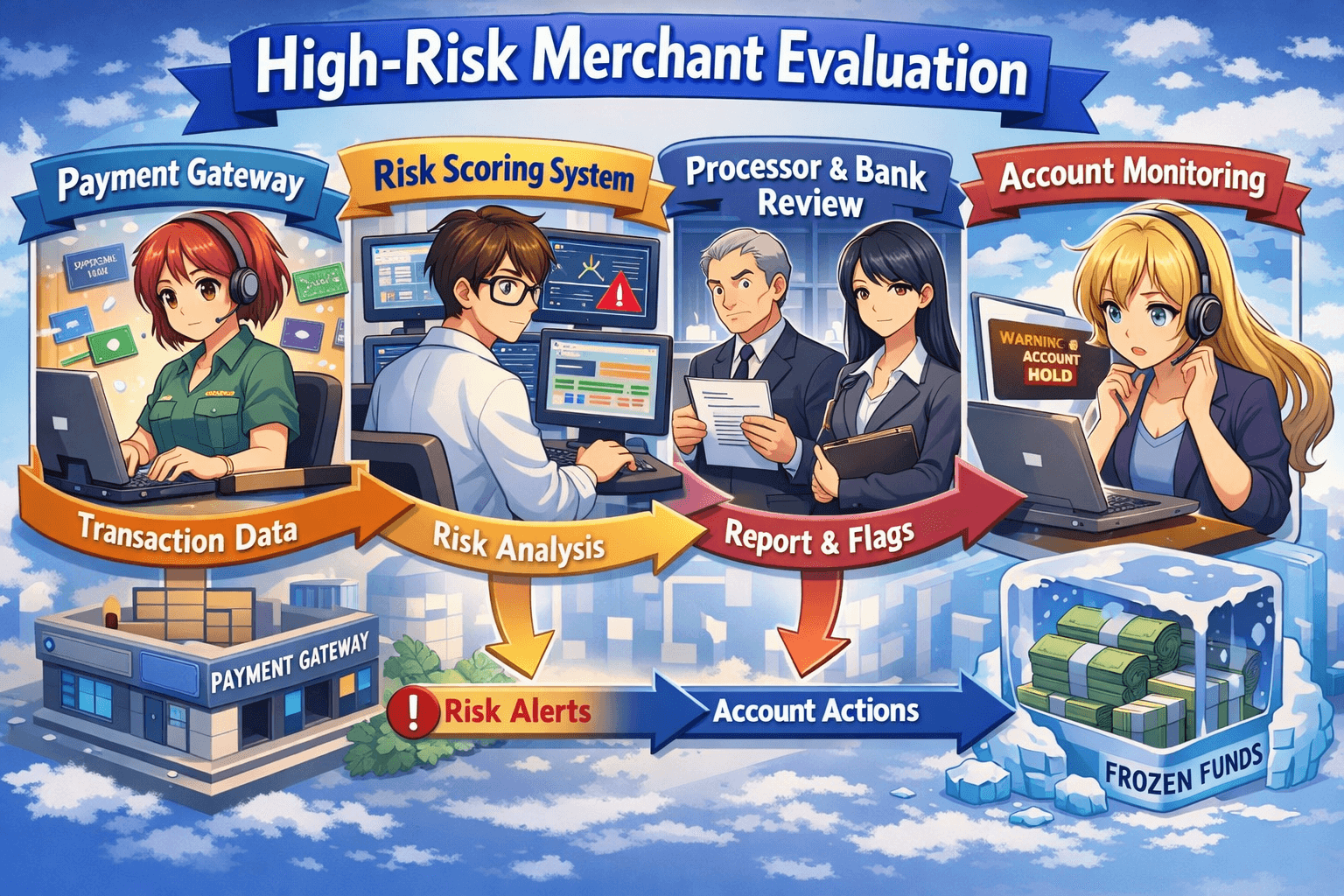
When people say a payment gateway is “evaluating” a merchant, they are usually describing a risk assessment process that spans multiple systems.
In practice, evaluation is not a one-time approval event. It is an ongoing risk review loop that combines automated monitoring with periodic human oversight. The goal is not to judge product quality, but to determine whether transaction activity fits within acceptable risk tolerances.
This distinction matters because most shutdowns are not triggered by a single mistake, but by cumulative signals over time.
The layers involved in merchant evaluation
Although gateways are part of the payment stack, they do not operate in isolation. Evaluation typically involves three layers:
𝟏. Transaction routing systems
These observe authorization success rates, declines, retries, and velocity changes.
2. Risk engines
Automated models score merchants based on dispute patterns, refund behavior, customer complaints, and category characteristics.
3. Oversight entities
These may include compliance teams or banking partners who interpret whether activity remains acceptable under policy.
From the merchant’s perspective, these layers often feel unified, but internally, they serve different functions.
Why certain merchants are labeled “high-risk”
The term “high-risk” is structural, not moral.
Merchants are typically placed in higher-risk categories due to factors such as:
- Product classifications with regulatory ambiguity
- Elevated refund or dispute sensitivity
- Subscription or continuity billing models
- Historical category-level losses (even if the merchant is new)
Importantly, individual behavior does not always override category risk. This is one reason well-intentioned businesses can still face restrictions.
Continuous monitoring, not static approval
A common misconception is that once a merchant is approved, evaluation stops. In reality, monitoring is continuous.
Payment gateways and associated risk systems regularly assess:
- Dispute reason codes (not just ratios)
- Refund timing relative to complaints
- Customer communication patterns
- Sudden changes in volume or ticket size
- Website language consistency over time
Small deviations rarely matter on their own. Patterns do.
How website content factors into evaluation
Public-facing content plays a larger role than many merchants expect.
Risk systems may review:
- Product descriptions
- Educational content
- FAQs and disclaimers
- Testimonials or implied outcomes
The concern is not marketing style, but narrative alignment, whether what is sold, what customers expect, and how transactions are described all match.
When those narratives drift apart, disputes become more likely, which feeds back into risk scoring.
Human review usually happens late
Merchants often assume a human reviewed their business before action was taken. In many cases, the opposite is true.
Automated systems typically:
1. Flag elevated risk
2. Trigger restrictions or holds
3. Then route the account for human review
By the time communication occurs, the system has often already decided that risk exceeds tolerance. This is why explanations can feel limited or impersonal.
What evaluation is not
It’s equally important to clarify what evaluation does not involve:
- It is not a judgment of merchant intent
- It is not a negotiation process
- It is not designed to accommodate edge cases easily
Evaluation frameworks are intentionally conservative. They prioritize system stability over individual merchant nuance.
Where to go next (calmly)
If this page clarified how evaluation works, the next useful step is usually contextual depth, not action.
Some readers choose to:
- Learn how risk scoring actually accumulates
- Understand why certain categories are treated uniformly
- See how operational clarity is documented over time
Those paths are educational by design, not promises of outcome.