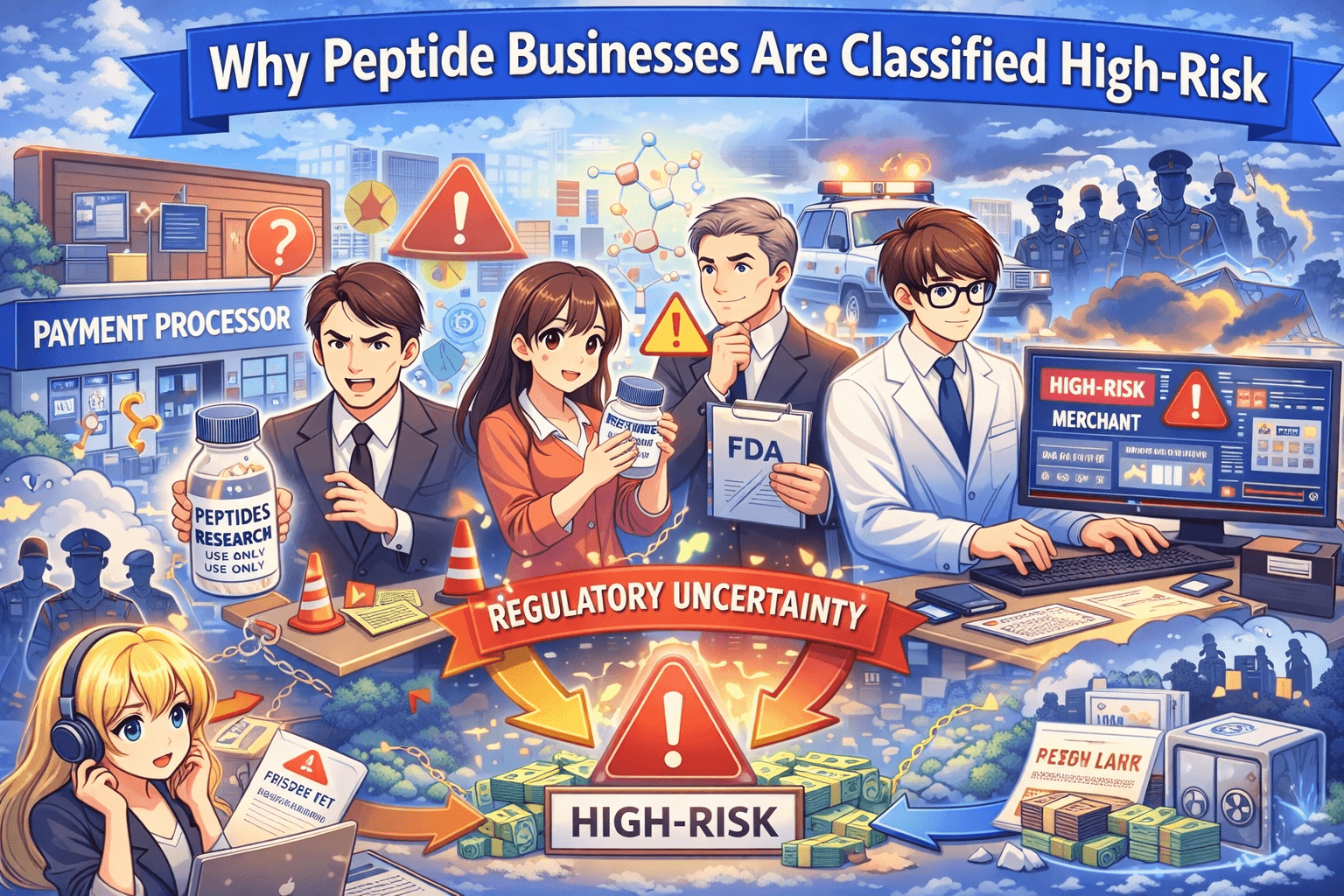
Why Peptide Businesses Are Classified High-Risk
Many peptide merchants operate carefully, avoid overt claims, and still find themselves classified as high-risk. This classification is rarely explained clearly. This page outlines why peptide businesses attract heightened scrutiny, how payment systems interpret them, and what drives risk decisions at a structural level.
Peptides occupy a regulatory gray zone
Peptides do not fit cleanly into existing commercial categories.
From a regulatory perspective, they are typically:
- Not approved pharmaceuticals
- Not regulated dietary supplements
- Often sold under research or laboratory-use representations
This ambiguity creates uncertainty for financial institutions. Payment systems are designed to prefer categories with clear, stable regulatory treatment. When classification is unclear, risk tolerance drops.
High-risk labeling, in this case, reflects uncertainty, not misconduct.
Classification risk versus behavior risk
For peptide businesses, risk assessment is driven less by merchant behavior and more by category interpretation.
Even well-run operations may be flagged because:
- Intended use can be interpreted multiple ways
- Customer behavior may differ from stated positioning
- External enforcement actions can shift interpretation quickly
Unlike some other verticals, strong operations alone do not fully offset category-level ambiguity.
The role of interpretation risk
Interpretation risk refers to the gap between:
- How a business describes its products
- How customers perceive or use them
- How regulators or banks might interpret that use
Peptides are particularly sensitive to this gap. Payment systems must account for how transactions could be viewed under stricter interpretation, not just how they are currently framed.
This leads to conservative classification decisions.
Ongoing monitoring, not one-time judgment
High-risk classification is not a single event.
Peptide businesses are typically subject to:
- Continuous transaction monitoring
- Periodic reassessment of category exposure
- Heightened sensitivity to disputes, complaints, or volume changes
Risk profiles are recalculated over time. A stable period does not eliminate scrutiny; it simply means signals have remained within tolerance.
Why category history matters
Payment systems rely heavily on historical loss data.
If a category has experienced:
- Regulatory actions
- Elevated dispute rates
- Reputational concerns
that history influences how new and existing merchants are evaluated, even if individual businesses differ significantly.
Peptide merchants often inherit this historical risk context.
Why clear intent is still not always sufficient
Many peptide businesses invest heavily in:
- Careful positioning
- Conservative language
- Clear disclaimers
While these efforts matter, they do not fully remove risk because payment systems must consider how intent could be challenged, not just how it is stated.
This is a structural limitation, not a reflection of merchant credibility.
What high-risk classification does not mean
It’s important to clarify what this classification does not imply:
- It does not mean a business is doing something wrong
- It does not indicate bad faith or deception
- It does not predict enforcement outcomes
High-risk status simply reflects how uncertainty is managed within financial systems.
A stabilizing perspective
Peptide businesses are classified as high-risk not because of a single factor, but because they sit at the intersection of regulation, interpretation, and historical sensitivity.
Understanding this framework helps merchants:
- Separate structural risk from personal responsibility
- Interpret reviews and restrictions more clearly
- Make informed decisions without assuming hidden judgments
Clarity does not eliminate risk, but it reduces confusion.
Where to go next (calmly)
If this explanation was useful, some readers choose to explore:
- How payment systems evaluate high-risk merchants across categories
- The difference between product classification and merchant behavior
- How operational clarity is reviewed during payment assessments
These paths are educational by design and intended to deepen understanding, not prompt action.