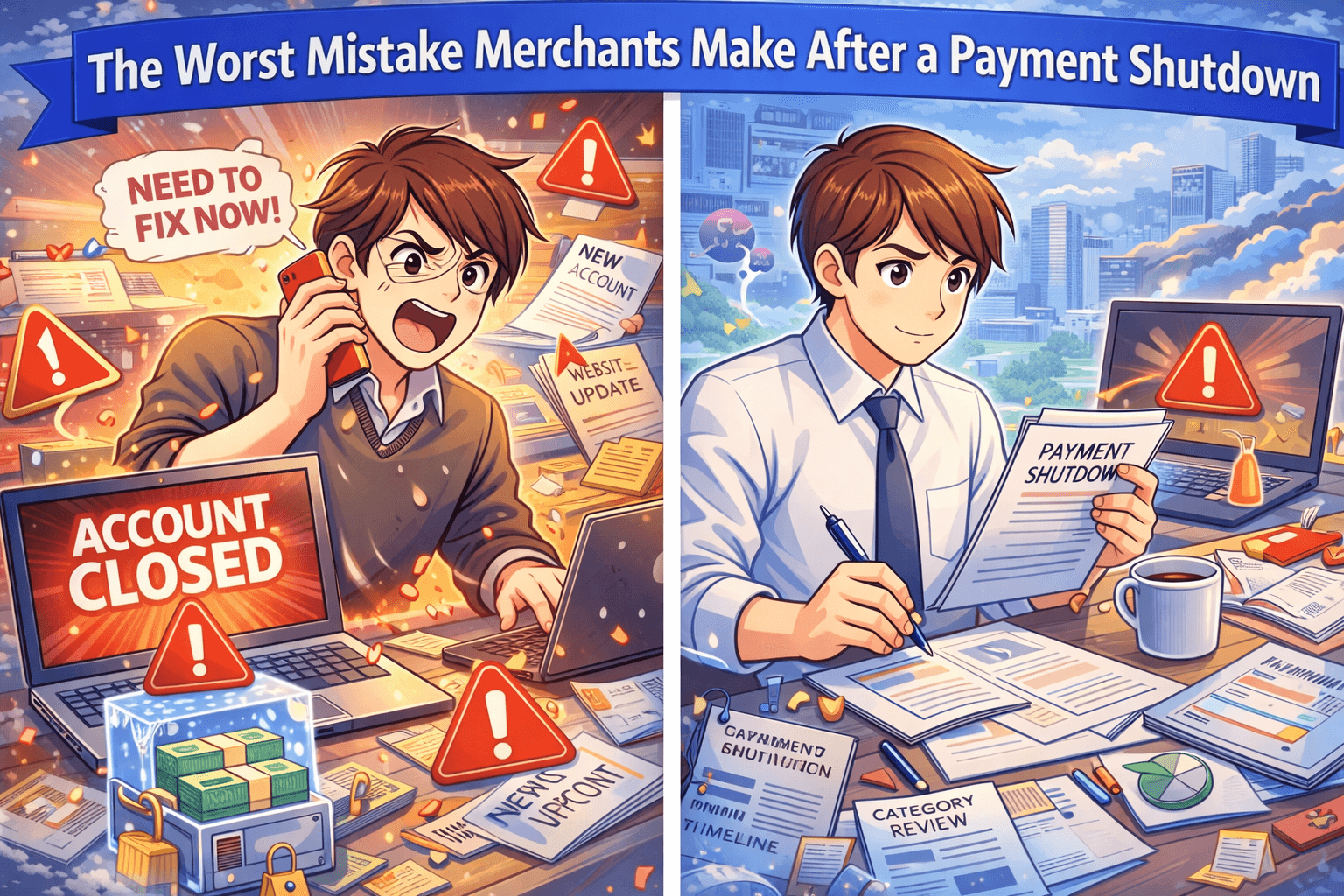
The Worst Mistake Merchants Make After a Payment Shutdown
A payment shutdown is destabilizing. Funds may be frozen, communication is limited, and timelines are unclear. In that moment, many merchants act quickly, not because they are careless, but because uncertainty is uncomfortable. Unfortunately, the most common response after a shutdown is also the one most likely to make recovery harder.
This article explains that mistake and why it backfires.
The instinct to “fix it immediately”
After a shutdown, most merchants experience the same pressure:
- Revenue has stopped
- Obligations continue
- Information is scarce
The instinctive reaction is to do something, anything that feels like progress.
That urgency is understandable. It is also where the worst decisions usually begin.
The mistake: treating a shutdown as a technical problem
The most damaging mistake merchants make is assuming a payment shutdown is a technical interruption rather than a risk decision. This confusion often comes from not fully understanding what actually triggered the shutdown in the first place.
This leads to behaviors such as:
- Rapidly seeking alternative processing paths
- Making sudden changes to websites or messaging
- Opening new accounts without context
- Reframing the business before understanding the issue
These actions are not malicious. They are reactive.
Unfortunately, they often compound risk.
Why reactive changes increase scrutiny
Payment shutdowns are rarely isolated events. They are typically logged across systems and entities. This broader context makes more sense when merchants understand how processors evaluate risk over time, rather than viewing shutdowns as isolated failures.
When merchants respond with sudden structural changes:
- Historical context becomes harder to interpret
- Inconsistencies appear in public records
- Narrative alignment breaks down further
- Risk signals multiply instead of reset
From the outside, this looks less like resolution and more like instability.
Why silence feels unbearable, but matters
Another common reaction is persistent outreach:
- Repeated emails
- Escalation attempts
- Requests for detailed explanations
While clarity is reasonable to want, aggressive communication rarely accelerates outcomes. In some cases, it can narrow future options by creating documented friction.
Most payment systems are not designed for negotiation at this stage. They are designed for containment and review.
The cost of moving too fast
Merchants often underestimate the long-term cost of post-shutdown decisions.
Moving quickly can:
- Lock in assumptions that are hard to reverse
- Create records that follow the business forward
- Reduce credibility in later reviews
- Eliminate patient, lower-risk paths unintentionally
Speed feels productive. In high-risk environments, it is often expensive.
What experienced merchants do differently
Merchants who have been through shutdowns before tend to behave differently, not because they care less, but because they understand the system.
They tend to:
- Pause before restructuring
- Separate emotional urgency from operational decisions
- Focus on understanding why before deciding what
- Avoid actions that create new unknowns
This restraint does not guarantee outcomes, but it preserves optionality.
What the worst mistake is not
It’s important to clarify what this mistake is not:
- It is not caring too much
- It is not asking questions
- It is not wanting resolution
The mistake is confusing motion with progress.
In payment systems, especially for high-risk merchants, uncoordinated motion often adds noise rather than clarity.
A steadier way to frame the moment
A shutdown is not a deadline. It is a change in posture.
When merchants reframe the event as:
- A signal to slow down
- A moment to observe rather than act
- A point of reassessment, not reinvention
they reduce the chance of making irreversible decisions under stress.
Why this perspective matters
Most damage after a shutdown happens after the shutdown itself.
Understanding this doesn’t remove the stress, but it can prevent a difficult situation from becoming permanently limiting.
For many merchants, the most important action after a shutdown is not action at all, it is restraint.