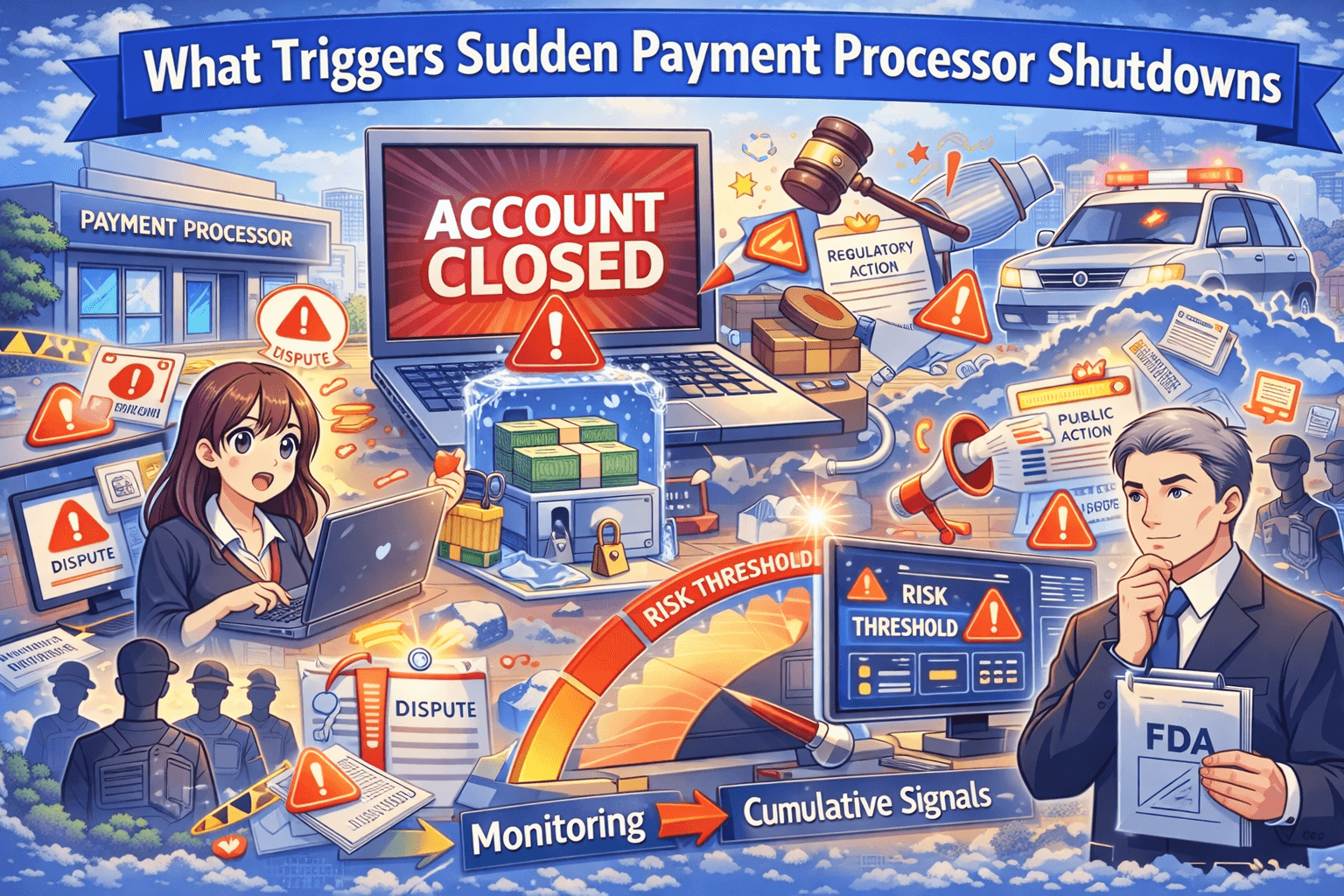
What Triggers Sudden Payment Processor Shutdowns
Payment processor shutdowns often feel abrupt. One day transactions are flowing, and the next an account is restricted or closed with little explanation. These events are rarely spontaneous. They are usually the visible outcome of risk signals that have been accumulating quietly over time. This page explains what typically triggers sudden shutdowns and why they appear without warning.
“Sudden” does not mean unreviewed
From a merchant’s perspective, shutdowns feel instantaneous. From a processor’s perspective, they are usually the final step in a longer evaluation process.
Risk systems monitor accounts continuously. When predefined thresholds are crossed, action is triggered automatically. Human review often happens after restrictions are applied, not before. This sequencing is intentional and designed to limit exposure quickly. This ongoing monitoring process is part of how processors evaluate high-risk merchants over time, rather than reacting to a single event.
The result is speed, not conversation.
Cumulative risk signals reaching a threshold
The most common trigger for shutdowns is signal accumulation.
Examples of signals include:
- Gradual increases in dispute frequency
- Changes in dispute reason codes
- Refund timing that lags behind complaints
- Inconsistent transaction patterns
- Shifts in customer behavior or geography
Individually, these signals may appear minor. Collectively, they can push an account past a tolerance limit that the system cannot ignore.
Category sensitivity amplifies small changes
For high-risk categories, including peptides and other regulated-adjacent products, baseline tolerance is already lower.
This means:
- Smaller deviations matter more
- Historical category data weighs heavily
- Processors act earlier than they would in low-risk verticals
Merchants often misinterpret this as unfair treatment, when it is actually category-level risk management. This lower tolerance is rooted in why peptide businesses are classified high-risk within payment systems, not in individual merchant intent.
Dispute context matters more than dispute ratios
Many merchants focus on headline metrics, such as keeping disputes below published thresholds. However, context often matters more than percentages.
Risk systems analyze:
- Why customers dispute
- Whether disputes suggest misunderstanding
- Whether descriptors or product descriptions are involved
- Whether complaints escalate externally
A low dispute rate can still trigger concern if the meaning of those disputes signals confusion or misalignment.
Website and communication drift
Shutdowns are frequently preceded by narrative drift, even when merchants are unaware it has occurred.
This can include:
- Gradual changes in product language
- Educational content that edges toward implication
- Testimonials that suggest outcomes
- FAQs that conflict with checkout or policy language
Processors evaluate public content as part of risk assessment because it shapes customer expectations. When expectations and transactions diverge, disputes follow.
External events outside merchant control
Some shutdowns are triggered by factors unrelated to the merchant’s recent behavior.
These include:
- Regulatory actions affecting the broader category
- Enforcement actions against similar businesses
- Media attention or public complaints
- Changes in internal processor policy
When these events occur, processors may reassess entire categories, not just individual accounts.
Automated systems prioritize containment
It is important to understand what payment systems are designed to optimize for.
They prioritize:
- Loss containment
- Regulatory compliance
- Network stability
They do not prioritize:
- Individual merchant nuance
- Gradual conversations
- Case-by-case exceptions
Once a system determines risk exceeds tolerance, action is taken first and explained later, if at all.
Why explanations are often limited
Merchants often receive brief or vague messages after shutdowns. This is not necessarily intentional opacity.
Limitations exist because:
- Risk models are proprietary
- Explanations can create liability
- Decisions may involve multiple parties
As a result, communication is typically minimal and procedural.
What a shutdown does not indicate
A sudden shutdown does not automatically mean:
- Fraud was detected
- The merchant acted in bad faith
- The business is being accused of wrongdoing
In most cases, it indicates that uncertainty exceeded what the system was designed to tolerate.
A stabilizing perspective
Sudden payment processor shutdowns are rarely personal, but they are often destabilizing. Understanding the mechanisms behind them helps merchants separate emotion from structure.
When shutdowns are viewed as system responses to accumulated signals rather than sudden judgments, they become easier to contextualize, even if they remain disruptive.
Because shutdowns are often driven by interpretation rather than intent, some merchants focus on improving operational documentation and review readiness so their activity is easier to understand during future assessments.
Where to go next (calmly)
Some readers choose to deepen their understanding by exploring:
- How processors evaluate high-risk merchants overall
- How risk scoring models accumulate signals over time
- How category classification influences tolerance thresholds
These paths are educational in nature and intended to clarify systems, not suggest actions.