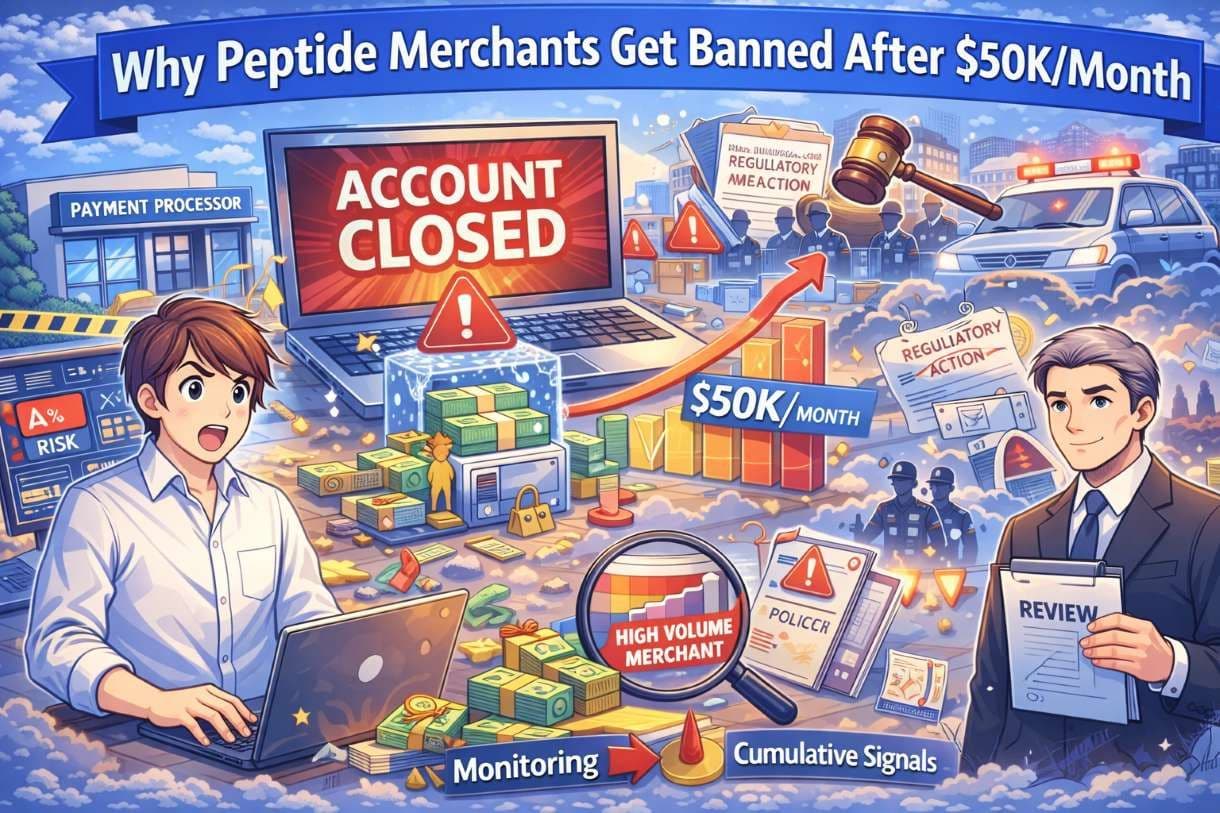
Why Peptide Merchants Get Banned After $50K/Month
Many peptide merchants report the same pattern: steady growth, clean operations, then a sudden payment shutdown shortly after reaching around $50,000 per month in volume. The number itself is not a rule or a trigger. But the change it represents often is. This article explains why growth can increase scrutiny and why shutdowns frequently occur at that stage.
The $50K mark is a signal, not a limit
Payment processors do not enforce universal revenue caps for peptide businesses. There is no formal threshold where an account is automatically banned.
However, crossing certain volume levels often changes how an account is evaluated internally. This shift is largely driven by how peptide businesses are classified high-risk, rather than the revenue number itself.
At higher volumes:
- Financial exposure increases
- Loss potential scales quickly
- Regulatory interpretation risk becomes more material
What felt tolerable at lower volume may no longer be acceptable once transactions reach a level where consequences multiply.
Growth changes how risk is modeled
Risk systems are designed to respond to changes, not just absolute values.
When a peptide business grows:
- Transaction velocity increases
- Average ticket sizes may shift
- Customer mix often broadens
- Dispute impact grows, even if rates remain stable
This causes risk models to recalculate assumptions. In high-ambiguity categories, those recalculations often move conservatively.
Why peptide businesses face sharper inflection points
Peptide merchants are evaluated differently from many other online businesses.
Because peptides sit in a regulatory gray zone:
- Intended use is open to interpretation
- Customer behavior may diverge from positioning
- External scrutiny can shift suddenly
As volume grows, processors must consider not just current behavior, but how that behavior could be interpreted at scale.
This makes growth itself a risk factor.
The role of cumulative signals
Shutdowns after growth spurts are rarely caused by a single event.
More often, they occur when:
- Small, previously tolerated signals accumulate
- Monitoring systems detect pattern reinforcement
- Category sensitivity lowers tolerance thresholds
Signals that might have been logged but ignored at lower volume can become decisive once exposure increases.
Why merchants feel blindsided
From the merchant’s perspective:
- Metrics may look stable
- Dispute rates may be low
- Operations may feel unchanged
What’s invisible is the internal shift in evaluation posture.
Processors do not typically notify merchants when:
- Monitoring intensity increases
- Category reviews are escalated
- Internal risk assumptions change
The first visible sign is often the shutdown itself.
This pattern aligns closely with what triggers sudden payment processor shutdowns, where accumulated signals only surface once exposure increases.
External factors often coincide with growth
It’s also common for shutdowns to coincide with factors outside the merchant’s control, such as:
- Increased regulatory attention on peptides
- Enforcement actions against similar sellers
- Policy updates inside payment institutions
- Public complaints or media narratives
When these occur, higher-volume merchants are often reviewed first because they represent larger exposure.
Why explanations are minimal
After a shutdown, merchants often receive brief or vague explanations. This is frustrating but typical.
Limitations exist because:
- Risk logic is proprietary
- Multiple entities may be involved
- Detailed explanations increase liability
Silence or general language does not necessarily imply misconduct. It usually reflects institutional constraint.
What a post-growth shutdown does not mean
A shutdown after reaching $50K/month does not automatically mean:
- The business violated rules
- Fraud was detected
- Growth itself was “wrong”
In most cases, it means the business crossed into a different risk evaluation tier where ambiguity was no longer acceptable at that scale.
A grounding perspective
For peptide merchants, growth is not just a financial milestone. It is a risk inflection point.
Understanding this does not make shutdowns easier, but it does make them less confusing. Many experienced merchants eventually realize that stability in this category depends as much on how growth is interpreted as on how it is achieved.
Where this fits (quietly)
Some readers use this perspective to:
- Reframe past shutdowns
- Better understand timing patterns
- Prepare emotionally for scrutiny that follows growth
This article is meant to explain the pattern, not justify it.